


Key Takeaways
- Cloud migration is not really a one-time event; it is a structured process. A lot of businesses that treat it like a simple lift-and-shift exercise end up with disruption that could’ve been avoided. When you use a phased approach, starting with assessment, workload prioritisation, and staged migration, you usually get results that feel more predictable than trying to move everything at once, in one go.
- Infrastructure readiness basically decides if the migration brings stability or chaos. Bandwidth, internal network capacity, endpoint security, and identity management all need a proper review before a single workload goes anywhere near the cloud. If there are gaps in any of those areas, they will show up pretty fast, and they can become very expensive once the migration is already underway.
- Some applications tend to perform better on private infrastructure, while others are more naturally suited to a hybrid model. A solid cloud migration strategy should map each workload to the right environment, instead of assuming the public cloud is the default response for everything.
- The right cloud service provider Malaysia partner matters more than the right platform. Platforms from major providers are broadly capable. What differentiates outcomes is the expertise of the partner who designs, configures, and monitors your environment.
- Post-migration management is where most businesses underestimate ongoing effort. The work does not end when data and applications are in the cloud. Monitoring, cost management, security patching, and capacity planning continue as ongoing responsibilities.
Introduction
For many business owners across Malaysia, the idea of cloud migration sits somewhere between an obvious next step and a risk they are not sure they are ready to take.
As of 2026, there are over 15,000 unfilled cybersecurity roles in Malaysia. The benefits sound compelling, but the questions underneath those promises are harder to answer without help. The blog presents an honest assessment of both arguments.
It explains the common obstacles that prevent businesses from successfully implementing their plans, cloud solutions in Malaysia, and the development of a migration strategy that maintains operational security at its current level.
It also provides a structured framework that helps you progress through your assessment process, whether you are just beginning to discuss the topic or have already started your evaluation.
What Cloud Migration Delivers, and What it Does Not?
The process of assessing readiness needs a clear definition, because we must understand which aspects of the cloud migration will succeed and which ones will fail.
- Reduced capital expenditure on hardware: Replacing physical servers with cloud infrastructure shifts IT spend from upfront capital outlay to predictable monthly operating costs. This frees capital for business operations and removes the cycle of hardware refreshes.
- Faster provisioning of new capacity: Adding storage, compute, or network capacity in a cloud environment takes minutes rather than weeks. For businesses in growth phases, this responsiveness has direct operational value.
- Improved access for distributed teams: Cloud-hosted applications and data can be accessed securely from any location with an internet connection. For Malaysian businesses with regional offices or remote teams, this removes the friction that on-premise infrastructure creates.
- Built-in redundancy options: Cloud providers run across many availability zones, so companies can set up geographic redundancy that would be outrageously expensive to copy on-premise, or at least, on the same scale.
- Access to managed services: Rather than maintaining databases, security tools, and monitoring systems inside the organisation, cloud environments offer managed versions of those services, which cuts down the whole internal technical workload.
What cloud migration does not automatically deliver:
- It requires real effort to manage, not just flipping a switch during migration.
- It shifts around, sure, but you still have to pay attention to it ongoing.
- It depends on how you configure access and monitor for threats. Poor setup could make it worse.
- If they were not built for the cloud, performance can drop because latency changes, or how databases connect and sessions are handled acts differently.
The actual results of cloud migration for most Malaysian companies show what their businesses will achieve through this process.

Choosing the Right Cloud Model: Public, Private, or Hybrid
Once infrastructure readiness has been mapped, the next decision is which cloud model fits your workloads. This is not a binary choice, and businesses in Malaysia increasingly operate across a mix of cloud environments depending on what each application demands.
| Cloud Model | How It Works | Best Suited For | Key Considerations for Malaysian Businesses |
|---|---|---|---|
| Public Cloud | Infrastructure shared across multiple organisations, managed entirely by the provider. Accessed via the internet or dedicated connections. | Development environments, SaaS applications, scalable storage, and workloads with variable demand | Data residency configuration is needed for compliance; egress costs accumulate with high data movement; a strong security configuration is required upfront |
| Private Cloud | Dedicated infrastructure hosted either on-premise or in a colocation facility. Resources are not shared with other organisations. | Regulated industries, sensitive data workloads, and legacy applications requiring dedicated resources | Higher upfront or ongoing infrastructure cost; requires a skilled internal team or managed service partner; limited elasticity compared to public cloud |
| Hybrid Cloud | A combination of public and private environments with a defined interconnection between them. Each workload is assigned to the most appropriate environment. | Businesses with mixed workload types: regulated data on private, scalable applications on public | Requires careful architecture design to avoid creating a fragmented environment; connectivity between environments must be secure and reliable |
| Multi-Cloud | Multiple public cloud providers are used simultaneously. Different providers may host different workloads or serve as redundancy for each other. | Enterprises wanting to avoid single-vendor dependency or needing best-of-breed services from different providers | Increases management complexity significantly; cost tracking across providers requires dedicated tooling; requires a team skilled across multiple cloud platforms |
For most small to mid-sized Malaysian businesses, a public cloud deployment with carefully configured security and data residency settings covers the majority of use cases.
Hybrid and multi-cloud approaches make sense for organisations with specific compliance requirements or complex workload portfolios, and in those cases, working with a qualified cloud service provider Malaysia partner to design the architecture is important before any implementation begins.
The Malaysian Cloud Environment and Global Platforms
There are way more cloud options for Malaysian businesses these days compared to before. Global big players have pushed into Southeast Asia more, and then some local providers focus on Malaysian rules for data and compliance.
- Take AWS Malaysia, for example. They put money into infrastructure right in the region, so companies can use their big services but with less delay from here.
- Beyond just the huge ones, the cloud scene in Malaysia has managed services, some homegrown platforms, and partners for hybrid setups.
- When picking between them, it comes down to what your workloads need, how much tech know-how your team has inside, the compliance you have to deal with, and obviously, the budget.
- That part about support stands out because not everyone is ready to dive in alone. Some options might overlap a bit, but it depends on the situation.
What is Post-Migration Management?
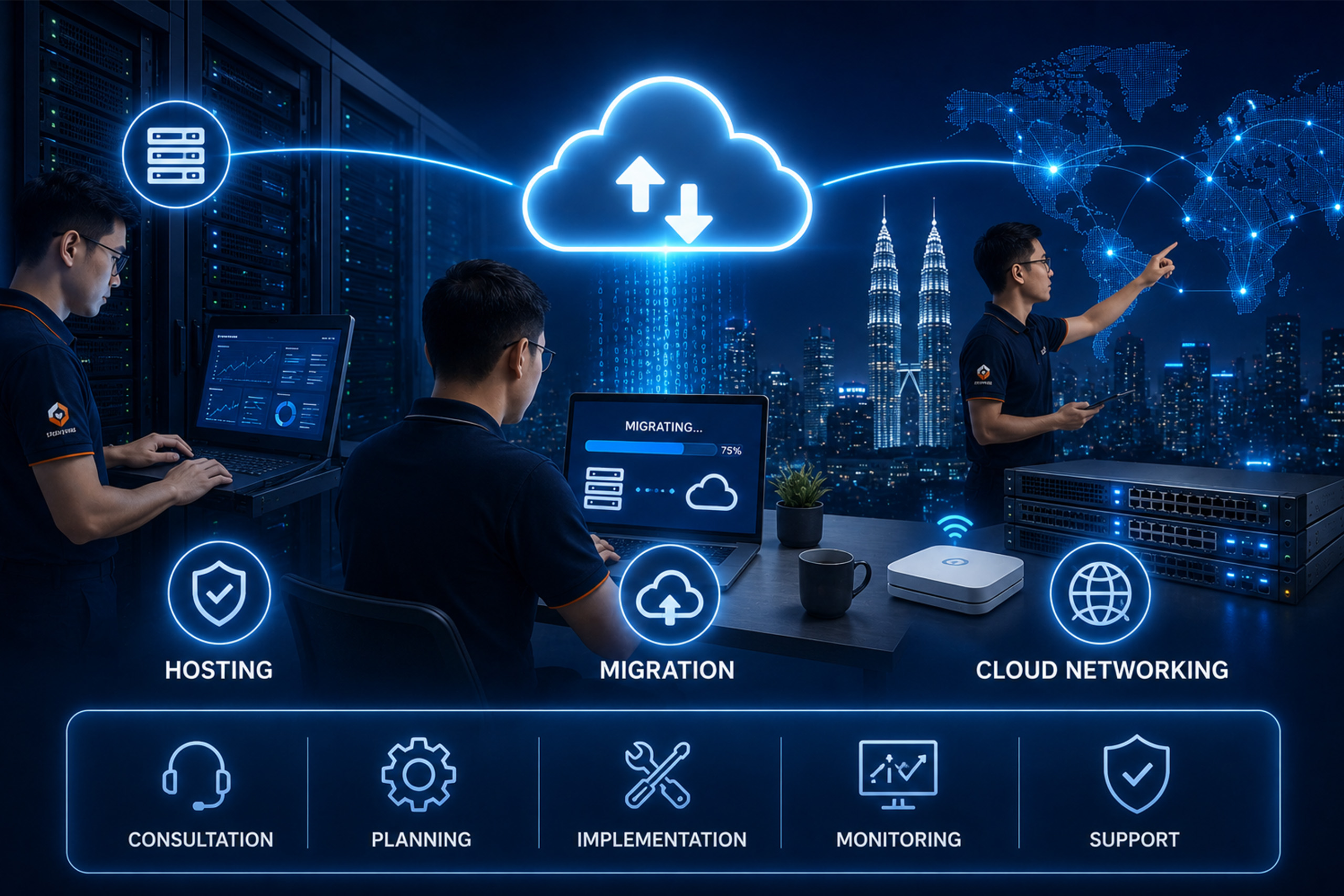
The finish line of a cloud migration is not the day your last workload moves to the cloud. Post-migration management covers several ongoing responsibilities that need to be planned for before migration, not after:
- One thing that stands out after moving to the cloud is how costs can just keep climbing if you are not paying attention.
- Security in the cloud feels different because there are so many more signals to watch, but only if you set up monitoring right from the start.
- Providers handle patching the base infrastructure, which is good, but then the operating systems and apps on top, plus container images, are all on you.
- Performance changes with business needs, so reviewing metrics against what resources you allocated makes sense.
- Compliance does not stop after migration, that is for sure. Regulations keep going, so reviewing data residency, access logs, and encryption policies every so often to check if things are still okay as the setup evolves.
- Cost stuff drifts up without management, yeah. Tagging policies tie into that, keeping expectations met. Optimisation opportunities from reviews, it all connects but not always smoothly.
It is the point at which your team is operating the cloud environment with the same confidence and control that they had over the on-premise infrastructure it replaced, and ideally more.
Conclusion
Readiness for cloud migration serves as a starting point that any business can reach with proper preparation. The most successful organisations take time to assess their current state honestly and move forward with a structured plan.
Build your cloud migration approach with help from VSTECS KU, Malaysia’s first AWS distributor with over 35 years in ICT distribution and a network of 45,000+ channel partners. Whether you are exploring AWS Malaysia deployment, backup planning, or hybrid infrastructure, our team supports enterprise operations across finance, government, healthcare, and education. Contact us at +603-6286 8222 to evaluate your setup and close migration gaps before rollout.
FAQs
1. How do I know if my Malaysian business is ready for cloud migration?
Readiness is assessed across several dimensions, such as technical infrastructure, data classification, internal team capability, compliance obligations, and operational processes.
2. What is the biggest risk in a cloud migration, and how can it be reduced?
Risks are reduced by investing in the assessment and planning phases before any workload moves, by running a validated pilot migration before tackling critical systems, and by working with a technology partner who has completed migrations in comparable environments.
3. How long does a cloud migration typically take for a mid-sized Malaysian business?
A small business migrating a handful of applications may complete the process in six to twelve weeks. A mid-sized business with complex infrastructure, multiple locations, and compliance requirements typically works across a six- to twelve-month phased programme.
4. What is the difference between a cloud provider and a cloud service provider Malaysia partner?
A cloud provider supplies the infrastructure, the servers, storage, networking, and managed services that form the platform. A cloud service provider Malaysia partner, by contrast, is the team that designs, configures, migrates to, and manages your environment on top of that infrastructure.
5. Will cloud migration reduce my IT costs?
It can, but cost reduction from cloud migration is not automatic. It depends on how well the environment is sized, how actively spending is governed, and whether on-premises infrastructure costs are genuinely eliminated as cloud workloads take over.